HP
HP FI-1000 printhead repair
The 297 mm HP Fixed Imager 1000 printhead itself — the part that fails in every FI-1000 based machine, whatever badge is on the front.
HP FI-1000 · industrial thermal inkjet
A fixed page-wide head cannot print around a fault — so the defect lands on every single piece.
The FI-1000 is one 297 mm array. There is no carriage motion to average anything out: when a die segment stops firing you get a continuous band of missing print in exactly the same place on every copy that comes off the machine.
That is why the diagnosis matters more than the repair. The same visible defect can mean a blockage worth an hour of flushing or a dead segment worth a new head, and only the nozzle test tells them apart.
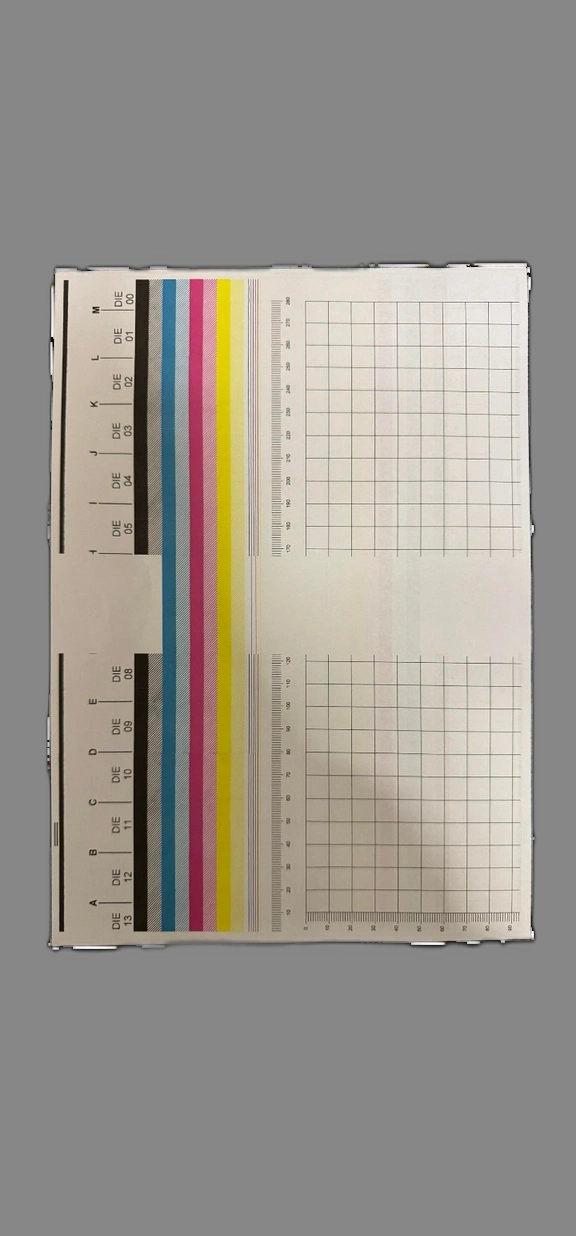
This is the table we work from — the same one for every FI-1000 machine.
| What you see | What it usually means | Outcome |
|---|---|---|
| A solid white band down the web, in the same place on every copy | A whole die segment has stopped firing | Sometimes recoverable — recovers if the cause is dried ink or blockage, not if the segment is electrically dead |
| Fine missing lines that partly return after a purge | Nozzles blocked by dried ink after idle time | Recoverable |
| Nozzles recover, then drop out again within a short run | Restriction upstream of the head — filter, line or supply pressure | Recoverable — replacing the head would not have fixed it |
| One colour channel weak or missing | Blocked feed or partially blocked die area on that channel | Recoverable |
| Density falling off across the width after long production | Nozzle plate contamination, worn wiper or failing capping | Recoverable — the capping and wiping station has to be serviced too |
| Head errors or refusal to come ready after running dry | Air drawn into the head during an ink starvation event | Recoverable — controlled purging and re-priming |
| Scratches or visible damage on the nozzle plate | Physical contact damage | Replacement head |
What this means Photograph the nozzle test before running any more recovery cycles. Repeated aggressive purging on a head that has already dried out is the most common way a recoverable fault becomes a replacement head.
What this means A full rebuild is $1,500 — one price for the job, not per sector. Lighter recovery work is quoted from the nozzle test, and replacement heads are available where recovery is not viable, along with ink at $200 per litre so the machine does not sit idle waiting on a second supplier.
The FI-1000 is an OEM engine sold under many badges, so the name on the machine rarely tells you what is inside.
HP
The 297 mm HP Fixed Imager 1000 printhead itself — the part that fails in every FI-1000 based machine, whatever badge is on the front.
Boxmaking Machinery GmbH
Single-pass packaging press built directly around the HP FI-1000, printing bags, boxes, mailers and envelopes at up to 27 m/min.
Printware / iJetColor
High-speed envelope and direct-mail press built on the HP FI-1000, launched by Printware in 2020.
Printware / iJetColor
Packaging-oriented member of the iJetColor Pro series using the HP FI-1000 fixed imager, launched at PackExpo 2021.
HSA USA
Single-pass digital printing system built on the HP FI-1000 for inline coding, marking and packaging print.
TICAB Print
TICAB industrial printing system in the HP FI-1000 class, used for packaging and industrial substrate printing.
Trimatt
Australian-built short-run packaging press family — the ColourStar AQ V and AQ LT run the HP FI-1000 engine, printing boxes, kraft bags and cotton totes at up to 27 m/min.
SMARTJET
Italian-built all-in-one overprinter for die-cut boxes, paper bags and untreated wood packaging — 297 mm at 1200 dpi and up to 27 m/min, on HP page-wide thermal inkjet.
Machine not listed? Send us the model and we identify the printhead for you.
Photograph or scan the nozzle test and describe what the machine was doing when the fault appeared. Do not keep running recovery cycles first — repeated aggressive purging on a head that has already dried out can turn a recoverable fault into a replacement.
We identify the failure pattern — sector, row or random dropout — and tell you whether recovery is realistic, before anything is dismantled.
You get the work scope and the price up front, including whether the ink delivery system needs service as well. No open-ended billing.
We recover the head where it can be recovered and supply a replacement where it cannot. Either way the machine goes back into production.
The nozzle test print itself, photographed flat and in focus. The machine make and model. What the machine was doing when the fault appeared — a long run, a restart after a weekend, a substrate change, an ink-out event. And whether any recovery cycles have already been run, and how many.
That is usually enough to name the failure mode without the head leaving your building.
Often, yes. Blocked nozzles, dried ink, contaminated ink paths, clogged filters and air-lock after ink starvation are recoverable in a large share of cases. Physical or electrical damage to a die segment is not recoverable by any process, and that head has to be replaced. Which case you have is determined from a nozzle test print before any work is quoted.
A full rebuild — clean, replacement of damaged sectors, refill with new original HP ink and a test print — is $1,500. Recovery work short of a rebuild is quoted from the nozzle test print, because the failure mode decides how much work there is.
A continuous band of missing print running along the direction of travel, in exactly the same position on every copy. Because the FI-1000 is a fixed page-wide head, it cannot print around the fault the way a scanning carriage printer can, so the defect appears on every piece.
Fourteen. That matters for a rebuild: we replace the ones that are actually dead rather than the whole assembly, which is why a rebuild is a fixed $1,500 instead of the price of a new head.
No. In most cases only the printhead assembly is shipped. Tell us the machine and we confirm exactly what has to come out and how to pack it so the head is not damaged in transit.
Repair is worth it when the fault is blockage, contamination or air-lock, because those recover. Replacement is the only option when a die segment is electrically dead or the nozzle plate is physically damaged. We tell you which one you have rather than selling the more expensive answer by default.
You get the likely root cause, whether it is recoverable, and what it costs — including when it is not worth spending the money.